 I went on a pilgrimage to Italy November 4-12, 2025 - particularly to visit the tombs of two newly canonized Saints: Pier Giorgio Frassati (Turin) and Carlo Acutis (Assisi), and to see the newly elected American Pope Leo XIV.
I went on a pilgrimage to Italy November 4-12, 2025 - particularly to visit the tombs of two newly canonized Saints: Pier Giorgio Frassati (Turin) and Carlo Acutis (Assisi), and to see the newly elected American Pope Leo XIV.
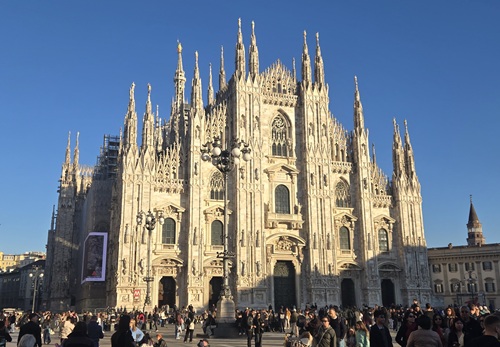
Duomo (of the Nativity), largest cathedral in Italy (outside the Vatican) and home of the tomb of St. Charles Borromeo (visited on his feast day!), and the baptistry where St. Augustine was baptized by St. Ambrose.
Mass local parish Church of Santa Maria di Lourdes in Milan.
Mass at Duomo Cathedral (of St. John the Baptist) - which houses the reliquary containing the Shroud of Turin and tomb of St. Pier Giorgio Frassati.
Basilica di Maria Ausiliatrice (Mary, Help of Christians) which has the tombs of St. John Bosco, St. Maria Domenica Mazzarello, St. Dominic Savio, and St. Giuseppe Benedetto Cottolengo. Tour the complex of the home for boys he founded (Valdocco).
I visited the twin churches of Santa Cristina and San Carlo Borromeo located in Piazza San Carlo.
Thursday, November 6: Florence
I visited Basilica di San Lorenzo, one of the largest and oldest churches in Florence, dating back to 393 AD and reconstruction in 1419. (Lots of artwork by significant
Mass at Basilica di Santa Trinita (Basilica of the Holy Trinity) in Florence.
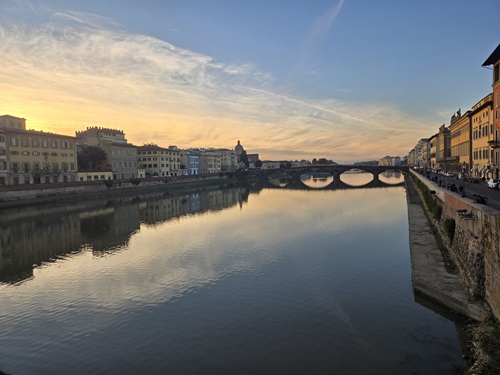
Walking tour of Florence with bridges over the Arno River and Piazza della Signoria (Duomo Square) with outdoor statues (admire Michelangelo's David). Tour of some of the most famous sites as we stroll the same streets Michelangelo, Leonardo Da Vinci, and Botticelli walked.
Florence's cathedral - Duomo di Firenze - that dominates the skyline. Visit the Baptistery chapel - the Baptistery of St. John - where thousands have received the Sacrament of Baptism - with its bronze Gates of Paradise showcasing fabulous castings of the Old Testament that seem to come to life.
Day 5 - Friday, November 7 Florence
Mass at Basilica of Santa Croce in Florence - with its 16 chapels of superb frescoes by Giotto and see where two of Italy's most famous Italians are buried: Michelangelo and Galileo.
Basilica of Santa Maria Novella - showcasing religious artwork prized throughout the world
Cathedral Duomo di Firenze and excavations underneath
Museum of the Duomo
A major exposition of Beato Fra Angelico was on display at Palazzo Strozzi, bringing together various works from major museums worldwide of this great Renaissance master.
Chiesa della Badia Florentina - after a long day on my feet, I stumbled across this church (near Dante's home) which was a hidden oasis of silence and Eucharistic Adoration in the heart of the bustling city.
Back to Santa Croce for a Gregorian Chant concert that night
Day 6 - Saturday, November 8 Siena
Pictures overlooking the city as we depart Florence on our way to Siena
Mass at St. Dominic's, St. Catherine of Siena's parish church where she attended daily Mass. The people of Siena wanted St. Catherine to be buried in her home church, but they were only able to procure her head, which is preserved for veneration in a reliquary.
Adjacent to the church is her birthplace and childhood home, which has been renovated throughout the centuries into a museum, now including several chapels and a cloister.
Explore the majestic Gothic Cathedral of Siena, also known as the Duomo di Siena, built in the 13th and 14th centuries, and dedicated to the Assumption of Mary
Basilica of St. Francis: venerating the Eucharistic miracle of Siena.
Day 7 - Sunday, November 9 Assisi
Basilica of St. Clare, which holds the famous San Damiano Crucifix that spoke to St. Francis, and relics of St. Clare's hair and St. Francis' poor patched tunic are kept.
Visit the family home of St. Francis where he was born, passing through the town square on the way to the Basilica of St. Francis, where we venerate this saint's burial place.
Mass at Convent of San Damiano where St. Clare lived with her nuns in 1241. Here, even though bedridden, St. Clare got up and held the Blessed Sacrament in the air and saw the advancing Saracen army flee in terror, thus establishing "The Miracle of the Eucharist of Assisi." Also in the convent is the chapel where Jesus spoke to St. Francis from the crucifix.
Shrine of Renunciation (St. Mary Major church) - This shrine was built to commemorate the spot where St. Francis renounced his wealth and family and began his life of poverty. It is now where the tomb of St. Carlo Acutis lies. The first Millennial Saint, who dedicated part of his short life to cataloging Eucharistic Miracles from around the world.
Cathedral of Assisi where Francis and Claire were baptized, and now a side chapel with the heart of St. Carlo in a reliquary.
Day 8 - Monday, November 10 Assisi / Orvieto / Rome
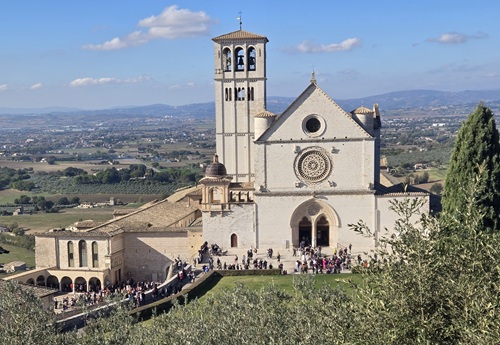
Before departing Assisi, we visit St. Mary of the Angels Basilica, site of the Porziuncola, the tiny church in the woods where St. Francis began his ministry and where St. Clare began her religious life.
Orvieto, a walled town high on a hill whose cathedral holds one of the greatest Eucharistic Miracles in its cathedral. In nearby Bolsena, a priest doubted the Eucharistic Presence during Mass and the host turned to real flesh and the wine to real blood during the consecration. The priest brought the blood-stained Corporal to Pope Urban in Orvieto, and it is now kept in a special reliquary.
We had Mass in the crypt, and afterward explored the Duomo Church and the city of Orvieto, its walls and food, we continue to Rome.
Day 9 - Tuesday, November 11 Rome
Since our hotel is near St. John Lateran, we start the day climbing the Holy Stairs, where Christ walked; brought from the Holy Land by St. Helena in the 4th century.
Then we go to St. Mary Major for our first Jubilee Holy Door and Mass. See the tomb of Pope Francis, venerate the crib of Christ, view the famous icon attributed to St. Luke, and see inestimable artwork.
I stop by the Casa Santa Maria where I lived for two years (two pictures of the chapel).
We have a walking tour of the Forum of ancient Rome.
Visit the Rooms of Saint Ignatius (Camere di Sant'Ignazio) located next to the Church of the Gesu - the place where St. Ignatius of Loyola lived, prayed and worked from 1543 until his death in 1556.
In the Church of the Gesu venerate the resting place of St. Ignatius of Loyola and other notable Jesuits and admire the intricate frescoes and paintings of all the side chapels.
Not to be confused with the Church of St. Ignatius of Loyola we visited, with its famous ceiling and fake dome, and the tomb of Servant of God Felix Maria Cappello, SJ (1879-1962) where he was known as the confessor of Rome (and a professor of Canon Law).
The Pantheon's unique dome inspired Michelangelo to build the dome of St. Peter's. Finish our walking tour at Piazza Novona.
Stop at Santa Croce in Gerusalemme (Holy Cross in Jerusalem), which house relics of the Passion from the Holy Land (but there is a Mass going on).
Day 10 - Wednesday, November 12 Rome
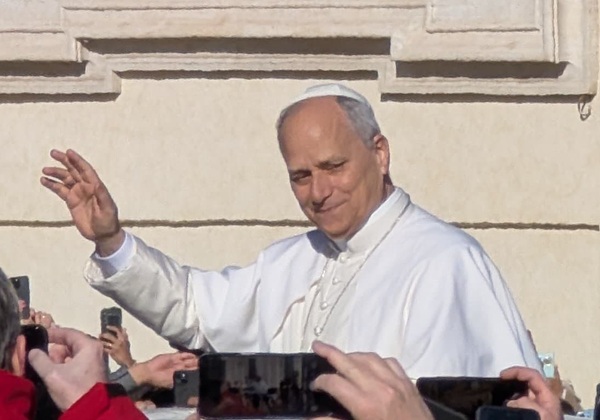
Attend the weekly Papal audience with Pope Leo.
Afterwards, we visit the Basilica of St. John Lateran, where we walk through our second set of Holy Doors.
St. Clement's Basilica, where we have Mass, see ancient frescos, and tour the excavations of the older church, on top of excavations of Roman ruins.
Day 11 - Thursday, November 13 Rome
Begin the day with Mass at St. Peter's Basilica, and our third Holy Jubilee Door.
Vatican Museums which house artifacts from around the world as we prepare ourselves for the greatest masterpiece yet: The Sistine Chapel. Painted by Michelangelo, it is the most famous ceiling in the world under which popes are chosen to lead the faithful.
Catacombs of St. Calistus - Here Christians celebrated the Mass in secret and buried the martyrs, including several popes.
St. Paul Outside the Walls and our final Jubilee Holy Door. Though it was destroyed by a fire in 1823, it was originally built by Constantine in the fourth century over the site of St. Paul's tomb and was rebuilt in the 19th century exactly as it was before the fire.
Depart Rome the next morning, Mass in Chicago airport.